Guide · Fall cleanup
Leave the leaves — a fall cleanup that does less, on purpose
Fallen leaves and dead stems are where next year’s butterflies, bumble bees and fireflies spend the winter. What to leave, where to move it, and how to keep a front yard looking deliberate.

YardRemake Studio
Published October 22, 2026 · 8 min read · 6 sections

On this page
Most fall cleanup is habit. You rake, bag and cut everything to the ground because that’s what a finished yard is supposed to look like in November — and along with the leaves, you can throw out next summer’s butterflies, bees and fireflies while they’re still overwintering in them.
The Xerces Society, the invertebrate conservation group behind the “Leave the Leaves” campaign, makes a simple case: a lot of insects spend the winter in exactly the material we tidy away. Here’s what to leave, where to move it, and how to keep the front of the house looking deliberate while you do less.
What’s living in the leaf litter
In cold climates, according to Xerces, the vast majority of butterflies and moths use leaf litter to get through winter — as eggs, caterpillars, chrysalises or adults. Woolly bear and great spangled fritillary caterpillars tuck themselves into leaf piles. Red-banded hairstreaks lay their eggs on fallen oak leaves, which become the caterpillars’ first meal. Luna moths wrap their cocoons in leaves, and swallowtail chrysalises are camouflaged to look like dry ones.
Bumble bee queens are down there too. After mating, they burrow an inch or two into the soil to hibernate, and Xerces describes an extra-thick layer of leaves on top as welcome protection. Fireflies use the same ground layer: Xerces lists leaf litter among the places their eggs, larvae and pupae are found, and Penn State Extension names firefly larvae among the animals a natural leaf layer shelters.
Bag the leaves and put them at the curb, and all of that goes with them.
Where the leaves should go
The lawn is the one place they can’t all stay. A thin layer is fine, even good for turf, but Xerces cautions that a couple of inches or more can smother it, and Purdue’s turf program warns that heavy leaf cover can kill grass and encourages snow mold.
So move them rather than remove them:
- Rake or blow leaves off the lawn into beds, around shrubs, and around the bases of trees. Xerces points out that fallen leaves do the same job as shredded wood mulch — suppressing weeds, holding moisture — for free.
- Keep them whole where you can. Running leaves through a mower shreds the eggs, caterpillars and cocoons in them, so Xerces recommends raking, or a leaf vacuum that collects whole leaves.
- Mow in only the thin scatter that’s left. For the grass itself, the research is on the mower’s side: Penn State says up to about half an inch of shredded leaves benefits a lawn, and Purdue found mulched leaves do no harm to soil or turf.
The sources genuinely pull in two directions here — turf specialists like mowing leaves in, insect specialists don’t. Our rule of thumb: rake first, into the beds; mow second, and only what the lawn can absorb.
Leave the stems standing
Leaves are half of it. The other half is the dead stalks of this summer’s perennials.
Many native bees nest inside hollow or pithy stems. Xerces notes that small carpenter bees carve nests in last year’s dead wildflower stems and raspberry canes, and that tiny yellow-faced bees move into the hollow centers of smaller stems such as bee balm. Xerces puts tunnel-nesting bees like these at about 30% of native bee species.
NC State Extension researchers sampled nearly 3,000 stems from 20 North Carolina gardens and found that bees mainly use stems in their second year, once they’ve been dead a while and broken or cut open. Stems in their first winter held no nests at all. That points to a simple routine:
- Leave stems up through winter. They’re also where the seeds are — more on that below.
- When you do cut, leave stubble. Xerces suggests cutting at varied heights from about 8 to 24 inches in early spring; NC State recommends 12 to 24 inches and says trimming first-year stems any time between the first fall frost and the last spring frost is fine. The new season’s growth comes up and hides the stubble.
- Don’t cut last year’s stubble again. Xerces’ advice is to leave those cut stems alone through the next spring’s cleanup, because they may now hold larvae or overwintering adults.
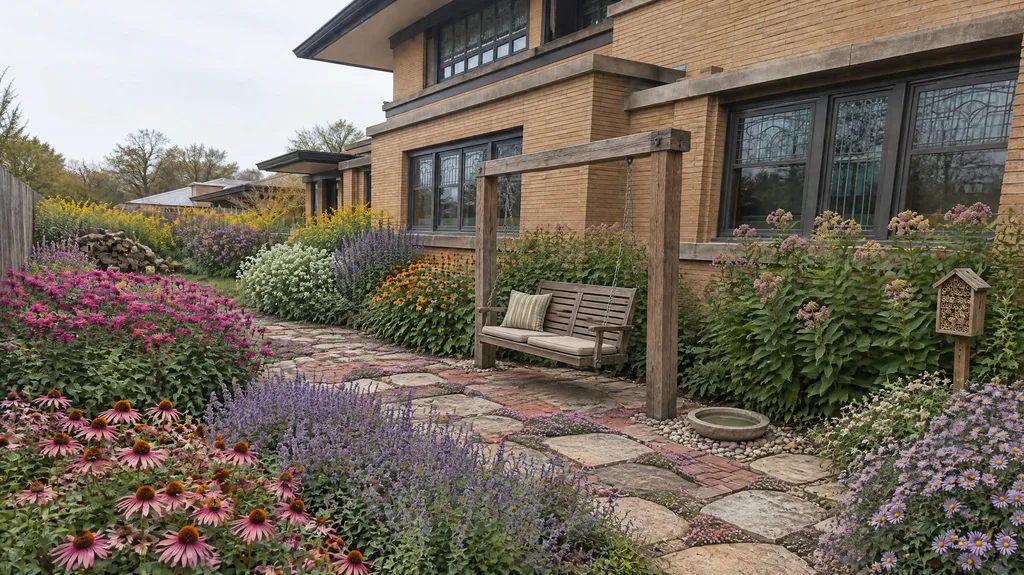
Xerces recommends stacking fallen branches and logs rather than hauling them away, which is what that pile is doing. See the full design for the complete plant list.
Seedheads are winter bird food
Xerces recommends leaving flower stalks and seedheads intact over winter because many birds feed on the seeds, naming sunflowers, asters, goldenrod, purple coneflowers, blazing stars and Joe Pye weed. Illinois Extension adds black-eyed Susan, whose spiky seedheads give a winter bed texture as well as food. The Missouri Botanical Garden notes that goldfinches visit the blackened cones of coneflowers left standing, and that little bluestem’s fluffy seedheads often last into winter and are eaten by birds.

Purple Coneflower

Black-eyed Susan

New England Aster

Goldenrod

Blazing Star

Joe Pye Weed

Bee Balm

Little Bluestem
When to clean up in spring
The honest answer: later than you’d like, and there’s no magic number.
You’ll often see a rule to wait until it’s consistently 50°F. Oregon State University horticulturist Gail Langellotto went looking for where that came from and couldn’t find a source — the closest match was a Wisconsin study of bat foraging in which most of the insects counted were aquatic flies. Her conclusion was that typical spring chores are unlikely to do broad harm to pollinators, the clear exception being cavity-nesting bees in pithy stems. For those, in Portland-area city gardens, she suggests waiting until May to clear out stem debris.
Xerces takes the more cautious line: if you pull leaves out of beds in spring at all, wait until late in the season, so butterflies, queen bumble bees and other overwintering animals have a chance to emerge first. What “late” means depends on your region, so take your cue from your own spring rather than a date.
What we’d actually do: leave the leaves in the beds for good as mulch, cut stems to stubble in late winter or early spring, and hold everything else until spring is well underway where you live.
Keeping it looking intentional out front
A border of brown stalks reads very differently behind the house than it does out front on a street of clipped lawns. The trick is to make the care visible.
Landscape researcher Joan Nassauer called these signals “cues to care” in a 1995 paper: visible signs that someone is looking after a place, such as trimmed hedges and mown lawn. (UF/IFAS Extension has a readable summary.) In a front yard, the cheapest ones are:
- A crisp bed edge. A clean line between lawn and bed says the wildness inside it is deliberate — the same missing edge we flagged in how to work out what’s wrong with your yard.
- A mown strip along the walk and the street, so the habitat sits inside a frame.
- Leaves in the beds, not on the paths or across the lawn.
- A small sign. Xerces suggests a pollinator or wildlife habitat sign to let the neighbors know the “mess” is intentional.
If you’re planning new beds with winter in mind, the pollinator, native and meadow style pages are good places to start. Our pollinator garden starter set loads coneflower, bee balm and black-eyed Susan for zones 4–9, and the Midwest prairie set pairs little bluestem and switchgrass with blazing star and butterfly weed.
This fall, edge the beds, clear the paths, move the lawn’s leaves into the borders, and leave the rest standing. It’s less work, and it’s the version of your yard that’s still alive in March.
Sources
- Xerces Society (Justin Wheeler, Scott Hoffman Black, Deborah Seiler; dated 2026-09-17) — Leave the Leaves
- Xerces Society — Leave the Leaves
- Xerces Society (2020, pub. 18-014) — Nesting & Overwintering Habitat for Pollinators & Other Beneficial Insects
- Xerces Society (Candace Fallon, 2025-07-31) — Are Fireflies Going Extinct? Here Are Six Ways To Make Sure They Survive
- Penn State Extension (Annette MaCoy, MG; updated 2025-01-22) — Leaves Are Treasure, Not Trash
- Purdue Turfgrass Science (Zac Reicher, 2005-10-24) — Keep Mowing to Mulch Those Tree Leaves!
- NC State Extension (Youngsteadt, Levenson, Rose, Glen; AG-984, 2025-05-22) — Garden Cleanup for Pollinators: Trim Perennial Stems in Their First Winter
- Oregon State University Extension (Gail Langellotto; EM 9498, 2021, reviewed 2025) — Should I wait to clean up the garden in order to help conserve insects?
- University of Illinois Extension (Brittnay Haag, 2024-10-07) — Consider plants with winter interest in landscapes
- Missouri Botanical Garden Plant Finder — Echinacea purpurea
- Missouri Botanical Garden Plant Finder — Schizachyrium scoparium
- UF/IFAS Extension (Mark Hostetler; WEC444/UW489) — Cues to Care: Are city landowners willing to make ecological landscapes?
