Guide · Deer country
Deer-resistant planting that still holds up in February
No plant is deer-proof. What Rutgers’ damage ratings actually say, which evergreens get eaten in winter, and the fences, repellents and tree guards that cover the gap.

YardRemake Studio
Published November 5, 2026 · 7 min read · 6 sections

On this page
Every garden center sells plants with a “deer resistant” tag, and in June the tag seems to work. Then February comes, the woods are bare, and the arborvitae along the property line is stripped up to the height of a deer’s reach.
The tag wasn’t lying, exactly. Deer resistance is a matter of odds, and the odds change with the season. Here’s how to read them, and what to do about the gap.
Nothing is deer-proof, and the experts say so first
The most useful list in the field is Rutgers Cooperative Extension’s Landscape Plants Rated by Deer Resistance, which rates more than 500 landscape plants in four bands:
- A — rarely damaged
- B — seldom severely damaged
- C — occasionally severely damaged
- D — frequently severely damaged
Rutgers’ advice is to build deer-prone landscapes from the A and B bands, and to plant C and D only with extra protection such as fencing or repellents. Before any of that, it says plainly that no plant is deer-proof, and that how any of them fares depends on your local deer numbers and the weather.
The weather part bites hardest in winter. UMass Extension notes that most damage to ornamentals happens in fall, winter and early spring, when food is limited, and that deer energy reserves bottom out in late winter and early spring. University of Georgia Extension goes further: when deer are plentiful and food is scarce, they’ll eat plants labeled deer-tolerant. So read an A as “rarely,” not “never.”
What deer tend to walk past
Extension sources agree on a short list of traits. UNH Extension boils it down to plants that are hairy, spiny, tough or strongly scented:
- Strong scent. Cornell Cooperative Extension in Tompkins County lists yarrow, Russian sage, lavender and culinary sage among the aromatic plants deer dislike. UGA adds catmint, thyme and mint.
- Fuzzy leaves. Lamb’s ear is the classic, with lungwort close behind.
- Prickly or tough leaves. Clemson’s Home & Garden Information Center puts hollies here, along with the sharp-toothed leaves of Lenten rose.
- Toxic plants. Clemson notes daffodils are poisonous, so deer leave them be. Compare tulips, which Rutgers rates D.
One caveat from UGA: deer sometimes browse a plant’s tender new growth, then leave it alone once the leaves mature. A resistant plant can look rough in its first weeks and still turn out fine.
The winter test: which evergreens get eaten
Evergreens are where the stakes are highest. UNH Extension notes that many of them are favorite winter food, and they’re usually the slow-growing, expensive bones of the yard. Rutgers’ ratings sort the usual suspects cleanly:
- Frequently severely damaged (D): American arborvitae, yews, rhododendrons and evergreen azaleas. UNH calls yews and arborvitae “generally irresistible” to deer.
- Occasionally severely damaged (C): western arborvitae, Japanese holly, blue holly, Nellie R. Stevens holly and eastern hemlock.
- Rarely damaged (A): common boxwood, American holly, Japanese pieris and Japanese plum yew.
That last one is the swap worth knowing. Japanese plum yew has foliage that resembles yew — hence the name — and the Missouri Botanical Garden says it handles shade better than most needled evergreens. It’s rated for zones 6 to 9.
Our rule of thumb: if a planting is your main winter view — the foundation bed, the screen along the street — build it from A and B plants, and keep any D-rated favorites where you can fence or cage them.
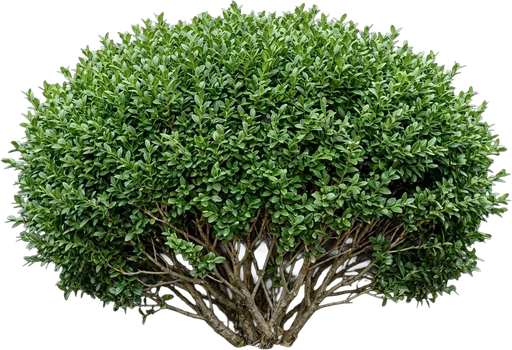
Common Boxwood

Japanese Plum Yew

Northern Bayberry

Russian Sage

Walker’s Low Catmint

Lamb’s Ear

Lenten Rose

Daffodil
When planting isn’t enough: fences, repellents and guards
Where deer pressure is heavy, plant choice lowers the damage. Only a barrier stops it.
Fences. The figure that recurs across extension sources — Cornell, UNH, UMass and the Morton Arboretum among them — is a fence at least 8 feet tall. Some go higher: Penn State Master Gardeners in Allegheny County note deer can clear 8 feet and suggest 10 to 12. Two designs get by with less height. A double fence works because deer won’t jump into a space where they’d be trapped, and a slanted fence set at a 45-degree angle, sloping away from the garden so it’s as wide as it is tall, works because deer avoid leaping a barrier that’s both wide and high (both from Penn State Master Gardener guides). For a small vegetable or cutting garden, Cornell says deer don’t like jumping into small enclosures, so a 4-foot fence can be enough. Whatever you build, put it up before the deer get a taste.
Repellents. None are 100 percent effective, UGA warns. Most need reapplying after rain and on new growth, and the University of Nebraska advises rotating types so deer don’t get used to one. UMass recommends starting in early fall, before deer settle into a feeding pattern, and cautions that repellents may not hold in late winter, when deer are hungriest.
Tree guards. Bucks rub their antlers on young trunks in late summer and early fall, ahead of the rut, and the Morton Arboretum says trees about 2 to 3 inches in diameter and larger are the usual targets. Repellents don’t stop rubbing, according to University of Maryland Extension. Physical barriers do: plastic tree wrap, tubes or 4-foot woven wire cylinders. Morton advises putting collars on in late summer and taking them off in spring so the trunk can expand.
Where the ratings fall short
- They’re regional. Rutgers compiled its list with nursery and landscape professionals, extension staff and Master Gardeners in northern New Jersey. Deer in Georgia or Minnesota may have other tastes.
- They’re observations, not trials. UGA says its own lists come mostly from trial and error rather than controlled studies. University of Maryland Extension adds that deer-resistance lists sometimes flatly contradict each other, because what deer eat depends on what else is available at that time and place.
- Good sources disagree. Rutgers rates mountain laurel C; UNH says deer largely ignore it. Rutgers rates western arborvitae C; the Morton Arboretum lists giant arborvitae as deer-resistant. When two solid sources split, plan for the worse rating.
The best data you’ll ever have is your own: what got chewed in your yard last winter, and when.
Start from a set that’s already been checked
If you’d rather not cross-reference ratings plant by plant, two of our starter sets were built for deer country. The Deer-Resistant Border (zones 5–8) leans on boxwood, Russian sage, catmint, lamb’s ear and daffodils, all rated A by Rutgers. Northeast Deer Country (zones 4–7) puts Norway spruce and Japanese tree lilac, both rated B, over bayberry, Lenten rose and Christmas fern, all rated A.
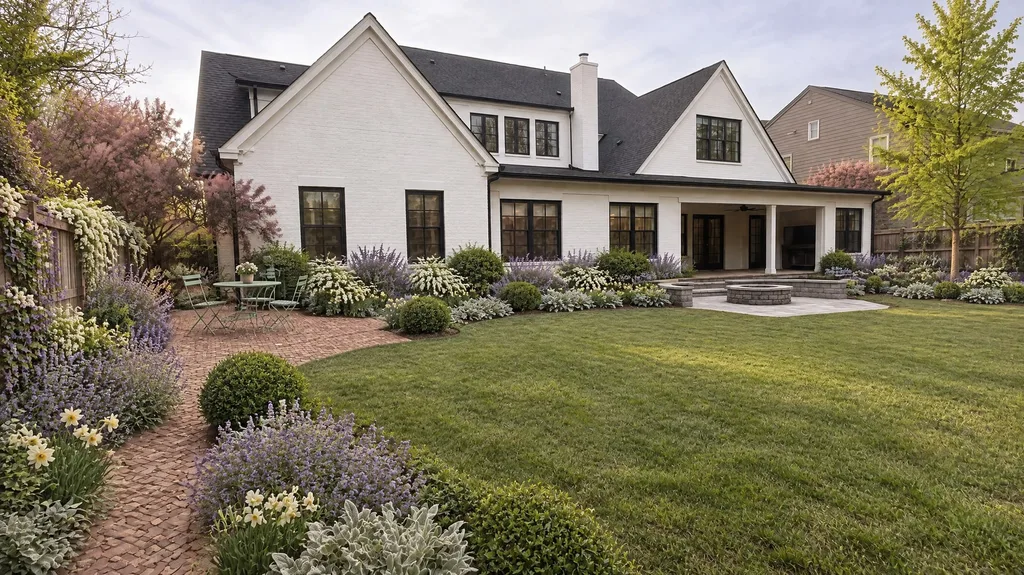
That’s the full design, with every plant listed. Any finished design lists its plants with a link to each one’s page, so checking a plan against the Rutgers list takes minutes rather than an afternoon.
Plant the A list where you look all winter, fence what you can’t live without, and walk the yard in February. That’s when you find out what your deer actually think.
Sources
- Rutgers NJAES Cooperative Extension — Landscape Plants Rated by Deer Resistance
- UMass Amherst CAFE (UMass Extension) — White-Tailed Deer and the Landscape
- UGA Extension — Deer-Tolerant Ornamental Plants
- UNH Extension — Keep the Deer Out of Your Garden This Winter
- UNH Extension — Which evergreen shrubs for privacy are deer resistant?
- Cornell Cooperative Extension of Tompkins County — Gardening With Deer Q&A
- Cornell CALS Integrated Pest Management — Deer
- Clemson HGIC — Deer-Resistant Gardening: 3 Plant Groups That Deter Browsing
- Clemson HGIC — Planting Deer Resistant Bulbs
- Missouri Botanical Garden Plant Finder — Cephalotaxus harringtonia
- University of Nebraska–Lincoln, Backyard Farmer — Managing Deer in Landscape
- The Morton Arboretum — Animal Damage to Plants
- The Morton Arboretum — Deer-Resistant Plants
- Penn State Extension, Master Gardeners of Allegheny County — Critter Control
- Penn State Extension, Chester County Master Gardeners — Large Garden Pests
- University of Maryland Extension — Deer Damage
- University of Maryland Extension — Deer Resistant Native Plants
